ChatGPT brand recommendations Ask ChatGPT for the best tool in almost any category, and it’ll answer instantly — no search required. Then ask it to search the web for the same thing, and something strange happens: the same names show back up.
That raises an uncomfortable question for anyone doing SEO or brand visibility work in 2026. If ChatGPT already knows who it’ll recommend before it searches, is the search step actually finding anything new — or just backing up a decision the model had already made?
We didn’t want to guess. So we ran the test.
The Strange Thing We Noticed
The pattern is easy to spot once you’re looking for it. . Ask an AI model for “the best X for a small business,” and it names a familiar handful of brands immediately, drawing only on what it already learned during training. Ask it to search the web for the same thing, and — often — those same brands reappear, just with fresher pricing and a citation attached.
That’s not necessarily deception. But it’s worth understanding why it happens, especially if part of your job is making sure your brand shows up in these answers.
Research backs up that this isn’t just a one-off observation. ChatGPT brand recommendations Studies on ChatGPT-based recommender systems have specifically identified popularity bias, where well-known items get recommended more often regardless of whether they’re the best fit for the stated criteria. Separate research has also found that prompt wording and framing can meaningfully shift what a model recommends, and that its judgments aren’t always logically consistent across similar prompts.
None of that proves a model “decides first and searches to justify it.” That’s a much stronger causal claim, and it needs a controlled test — so we ran one.
The Experiment: Three Rounds, One Category
We picked SEO tools for small businesses, since it’s directly relevant to anyone reading this. The test had three parts, each designed to isolate a different variable.
Round 1 — Baseline (no search): “What are the 5 best SEO tools for a small business? Rank them and explain why.”
Round 2 — Lesser-known candidates (no search): “What are 5 lesser-known SEO tools for a small business? Avoid the obvious market leaders.”
Round 3 — Live web search: “Search the web and identify the 5 SEO tools that best fit a small business with a limited budget, considering current pricing, features, and value. Cite your sources.”
ChatGPT brand recommendations One limitation worth stating upfront: this test ran within a single conversation rather than three fully isolated sessions, so there’s a small chance earlier answers influenced later ones. A stricter version of this experiment would run each round in a completely fresh session. We’re flagging that as a real constraint, not burying it.
What Actually Changed
Here’s what came out of each round.
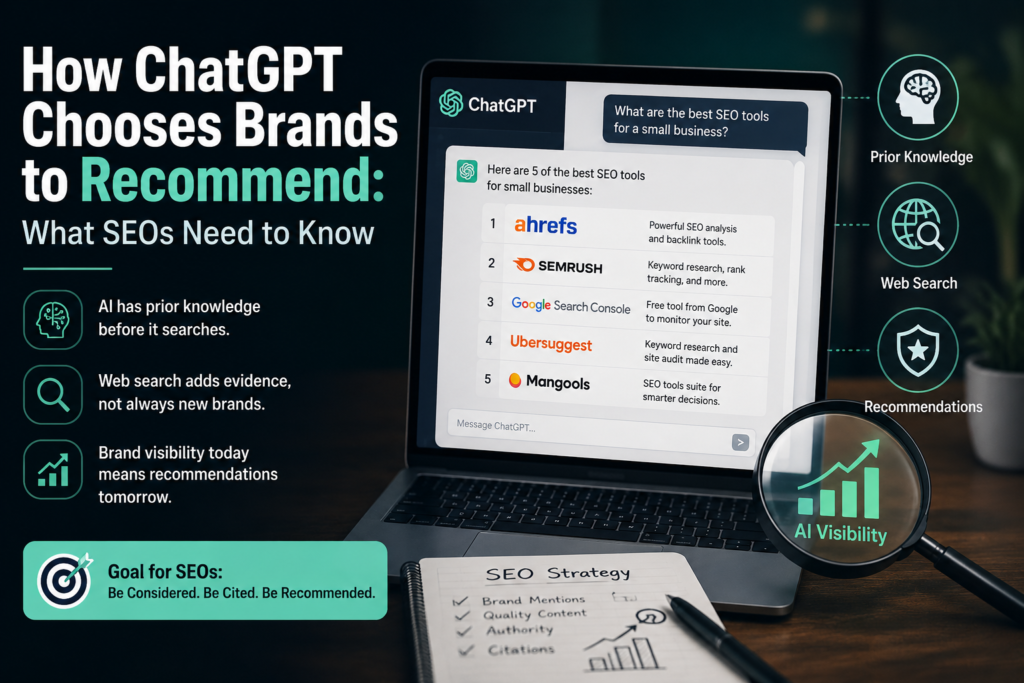
Round 1 (baseline) surfaced Ahrefs, SEMrush, Google Search Console, Ubersuggest, and Yoast SEO — the standard “big name” list anyone in SEO would recognize.
Round 2 (lesser-known) swapped in Serpstat, SE Ranking, Mangools, AnswerThePublic, and Screaming Frog. Better attempt at avoiding the obvious leaders, but still tools with real market presence.
Round 3 (search) returned Google Search Console, Mangools, Ubersuggest, SE Ranking, and Ahrefs — this time backed by actual 2026 pricing and sourced comparisons pulled from live pages.
| What we checked | What we found |
| Brands named before search | Ahrefs, SEMrush, Google Search Console, Ubersuggest, Yoast, Serpstat, SE Ranking, Mangools, AnswerThePublic, Screaming Frog |
| Brands that survived search | Google Search Console, Mangools, Ubersuggest, SE Ranking, Ahrefs |
Did “lesser-known” actually escape the big names? | Partially — SEMrush and Ahrefs dropped as headliners, but SE Ranking and Mangools turned out to be exactly what independent search results also confirmed as strong budget picks |
Did search introduce a genuinely new candidate? | No — every tool in the final answer had already appeared in Round 1 or Round 2 |
| What changed, if not the brands? | The reasoning. Search added real 2026 pricing and sourced comparisons; the pre-search answers were unsupported claims from training data |
The headline finding: the brand list barely moved. What search added wasn’t new candidates — it was evidence for candidates the model already favored.
Why This Happens (Without Assuming the Worst)
A few honest explanations, none of which require assuming the model is manipulating anything:
- Popularity bias. If Ahrefs, SEMrush, and Google Search Console dominate the training data on this topic, they’ll dominate the model’s default answer too. That’s a documented pattern in AI recommendation research, not a hidden agenda.
- Genuine market consensus. These tools also dominate independent, human-written buyer guides across the web. So when search “confirms” the pre-search answer, it may simply be because the popularity signal is real — not because the model was hunting for validation.
- Prompt interpretation. How a question is phrased measurably changes which candidates get surfaced, which is exactly why Round 2’s “lesser-known” framing shifted the list at all
- How ChatGPT Search actually works. OpenAI has described ChatGPT Search as rewriting a user’s prompt into a more targeted query and using web sources to enrich its answer — meaning search is often layered on top of an existing response rather than starting from zero.
What This Doesn’t Prove
It’s tempting to turn this into “ChatGPT brand recommendations” — but that’s a bigger claim than the data supports. ChatGPT brand recommendations This experiment doesn’t show the model deliberately searching for evidence to justify a predetermined answer. It shows that pre-search knowledge and post-search evidence tend to converge because they’re drawing on the same underlying popularity signal that exists across the web. That’s a more boring explanation, but it’s the honest one.
Why SEOs Should Care
Here’s the part that actually matters for your work: ranking in Google and being recommended by an AI system are related, but they’re not the same visibility problem.
You can rank on page one for “best SEO tools” and still never get named when someone asks ChatGPT the same question — because the model isn’t just indexing pages, it’s drawing on which brands show up repeatedly, independently, and consistently across the sources it has learned from or retrieves.
Being findable and being considered a strong candidate for recommendation are two different battles. Winning the first doesn’t guarantee you win the second.
How to Test This Yourself
You don’t need special tools to run this experiment for your own category. Try:
- Ask for “the best [your category]” with no search enabled.
- Ask again, specifically requesting lesser-known or alternative options.
- Ask a third time with search enabled, requesting current pricing and sources.
Then compare: Which brands appear in all three rounds? Did search introduce anyone new, or just add evidence for names that were already there? If your brand never shows up in any round, that’s a visibility gap worth investigating — separate from your traditional search rankings.
Practical Takeaway: Optimize to Be Considered, Not Just Found
Based on how these systems appear to work — and framed as reasonable inference, not proven ranking factors — three things are worth prioritizing:
1. Build a strong third-party entity footprint. Don’t rely only on your own website telling people you’re the best. Get discussed in industry publications, expert comparisons, reputable directories, podcasts, and genuine customer reviews. ChatGPT brand recommendations The goal isn’t backlink volume — it’s having independent sources consistently describe who you are and what you’re good at. Google’s own guidance points in the same direction, emphasizing authority and trust signals over self-promotion.
2. Make your own site unambiguous to machines. Clear entity signals matter: a consistent brand name, dedicated product pages, real author and About pages, strong internal linking, descriptive headings, and appropriate structured data. ChatGPT brand recommendations Structured data won’t directly make ChatGPT recommend you — but it gives search engines explicit clues about what your page actually means, which is a safer and more defensible claim.
3. Create evidence worth citing, not just content worth ranking. Skip the tenth generic “10 Best Tools” listicle. Publish something with original data — a pricing study across dozens of platforms, a first-hand test with real numbers, a transparent methodology. ChatGPT brand recommendations Google explicitly rewards original research and first-hand expertise over rewritten summaries, and that’s exactly the kind of content an AI search layer has a concrete reason to cite.
The underlying idea: don’t chase AI-specific hacks. Build a web presence that’s easy to identify, independently corroborated, and genuinely worth mentioning — by humans and AI systems alike.
FAQs
Does ChatGPT decide its answer before searching the web? Not exactly. It generates an initial response from what it already knows, and search can add to or refine that response — but our test found the underlying brand list often stays similar before and after search, largely due to popularity bias rather than deliberate manipulation.
Is this the same as traditional SEO ranking bias? It’s related but distinct. Traditional SEO rewards pages that rank well in search engines. AI recommendation visibility depends more on how consistently and credibly your brand is discussed across independent sources.
Can small or newer brands still get recommended by ChatGPT? Yes, but it typically requires building genuine third-party visibility — reviews, mentions, comparisons — rather than only optimizing your own website.
Should I stop investing in traditional SEO? No. Structured data, clear site architecture, and strong content remain foundational — they just aren’t sufficient on their own for AI recommendation visibility.
Methodology note: This experiment was run within a single conversation rather than fully isolated sessions, which is a limitation worth repeating for anyone replicating this test. A stricter version would run each round in a separate, fresh session to rule out any cross-influence between answers.
Ask an AI model for “the best X for a small business,” and it names a familiar handful of brands immediately, drawing only on what it already learned during training. ChatGPT brand recommendations Ask it to search the web for the same thing, and — often — those same brands reappear, just with fresher pricing and a citation attached.
That’s not necessarily deception. But it’s worth understanding why it happens, especially if part of your job is making sure your brand shows up in these answers.
This isn’t a singular observation, according to research. Popularity bias, in which well-known products are recommended more frequently regardless of whether they are the best fit for the specified criteria, has been explicitly observed in studies using ChatGPT-based recommender systems. Additionally, different studies have discovered that a model’s recommendations can be significantly altered by the phrasing and framing of prompts, and that its conclusions aren’t always logically consistent across similar prompts.
None of that proves a model “decides first and searches to justify it.” That’s a much stronger causal claim, and it needs a controlled test — so we ran one.
The Experiment: Three Rounds, One Category
We picked SEO tools for small businesses, since it’s directly relevant to anyone reading this. The test had three parts, each designed to isolate a different variable.
Round 1 — Baseline (no search): “What are the 5 best SEO tools for a small business? Rank them and explain why.”
Round 2 — Lesser-known candidates (no search): “What are 5 lesser-known SEO tools for a small business? Avoid the obvious market leaders.”
Round 3 — Live web search: “Search the web and identify the 5 SEO tools that best fit a small business with a limited budget, considering current pricing, features, and value. Cite your sources.”
One limitation worth stating upfront: this test ran within a single conversation rather than three fully isolated sessions, so there’s a small chance earlier answers influenced later ones. ChatGPT brand recommendationsA stricter version of this experiment would run each round in a completely fresh session. We’re flagging that as a real constraint, not burying it.
What Actually Changed
Here’s what came out of each round.
Round 1 (baseline) surfaced Ahrefs, SEMrush, Google Search Console, Ubersuggest, and Yoast SEO — the standard “big name” list anyone in SEO would recognize.
Round 2 (lesser-known) swapped in Serpstat, SE Ranking, Mangools, AnswerThePublic, and Screaming Frog. Better attempt at avoiding the obvious leaders, but still tools with real market presence.
Round 3 (search) returned Google Search Console, Mangools, Ubersuggest, SE Ranking, and Ahrefs — this time backed by actual 2026 pricing and sourced comparisons pulled from live pages.
| What we checked | What we found |
| Brands named before search | Ahrefs, SEMrush, Google Search Console, Ubersuggest, Yoast, Serpstat, SE Ranking, Mangools, AnswerThePublic, Screaming Frog |
| Brands named before search | Google Search Console, Mangools, Ubersuggest, SE Ranking, Ahrefs |
| Did “lesser-known” actually escape the big names? | Partially — SEMrush and Ahrefs dropped as headliners, but SE Ranking and Mangools turned out to be exactly what independent search results also confirmed as strong budget picks |
| Did search introduce a genuinely new candidate? | No — every tool in the final answer had already appeared in Round 1 or Round 2 |
| What changed, if not the brands? | The reasoning. Search added real 2026 pricing and sourced comparisons; the pre-search answers were unsupported claims from training data |
The headline finding: the brand list barely moved. What search added wasn’t new candidates — it was evidence for candidates the model already favored.
Why This Happens (Without Assuming the Worst)
A few honest explanations, none of which require assuming the model is manipulating anything:
- Popularity bias. If Ahrefs, SEMrush, and Google Search Console dominate the training data on this topic, they’ll dominate the model’s default answer too. That’s a documented pattern in AI recommendation research, not a hidden agenda.
- Genuine market consensus. These tools also dominate independent, human-written buyer guides across the web. So when search “confirms” the pre-search answer, it may simply be because the popularity signal is real — not because the model was hunting for validation.
- Prompt interpretation. How a question is phrased measurably changes which candidates get surfaced, which is exactly why Round 2’s “lesser-known” framing shifted the list at all.
- How ChatGPT Search actually works. OpenAI has described ChatGPT Search as rewriting a user’s prompt into a more targeted query and using web sources to enrich its answer — meaning search is often layered on top of an existing response rather than starting from zero
What This Doesn’t Prove
It’s tempting to turn this into “ChatGPT is rigged” — but that’s a bigger claim than the data supports. This experiment doesn’t show the model deliberately searching for evidence to justify a predetermined answer. ChatGPT brand recommendations It shows that pre-search knowledge and post-search evidence tend to converge because they’re drawing on the same underlying popularity signal that exists across the web. That’s a more boring explanation, but it’s the honest one.
Why SEOs Should Care
Here’s the part that actually matters for your work: ranking in Google and being recommended by an AI system are related, but they’re not the same visibility problem.
You can rank on page one for “best SEO tools” and still never get named when someone asks ChatGPT the same question — because the model isn’t just indexing pages, it’s drawing on which brands show up repeatedly, independently, and consistently across the sources it has learned from or retrieves.
Being findable and being considered a strong candidate for recommendation are two different battles. Winning the first doesn’t guarantee you win the second.
How to Test This Yourself
You don’t need special tools to run this experiment for your own category. Try:
- Ask for “the best [your category]” with no search enabled.
- Ask again, specifically requesting lesser-known or alternative options.
- Ask a third time with search enabled, requesting current pricing and sources.
Then compare: Which brands appear in all three rounds? Did search introduce anyone new, or just add evidence for names that were already there? If your brand never shows up in any round, that’s a visibility gap worth investigating — separate from your traditional search rankings.
Practical Takeaway: Optimize to Be Considered, Not Just Found
Based on how these systems appear to work — and framed as reasonable inference, not proven ranking factors — three things are worth prioritizing:
1. Build a strong third-party entity footprint. Don’t rely only on your own website telling people you’re the best. Get discussed in industry publications, expert comparisons, reputable directories, podcasts, and genuine customer reviews. ChatGPT brand recommendations The goal isn’t backlink volume — it’s having independent sources consistently describe who you are and what you’re good at. ChatGPT brand recommendations ChatGPT brand recommendations Google’s own guidance point ChatGPT brand recommendations s in the same direction, emphasizing authority and trust signals over self-promotion.
2. Make your own site unambiguous to machines. Clear entity signals matter: a consistent brand name, dedicated product pages, real author and About pages, strong internal linking, descriptive headings, and appropriate structured data. Structured data won’t directly make ChatGPT recommend you — but it gives search engines explicit clues about what your page actually means, which is a safer and more defensible claim.
3. Create evidence worth citing, not just content worth ranking. Skip the tenth generic “10 Best Tools” listicle. Publish something with original data — a pricing study across dozens of platforms, a first-hand test with real numbers, a transparent methodology. Google explicitly rewards original research and first-hand expertise over rewritten summaries, and that’s exactly the kind of content an AI search layer has a concrete reason to cite.
The underlying idea: don’t chase AI-specific hacks. Build a web presence that’s easy to identify, independently corroborated, and genuinely worth mentioning — by humans and AI systems alike.
FAQs
Does ChatGPT decide its answer before searching the web? Not exactly. It generates an initial response from what it already knows, and search can add to or refine that response — but our test found the underlying brand list often stays similar before and after search, largely due to popularity bias rather than deliberate manipulation.
Is this the same as traditional SEO ranking bias? It’s related but distinct. Traditional SEO rewards pages that rank well in search engines. AI recommendation visibility depends more on how consistently and credibly your brand is discussed across independent sources.
Can small or newer brands still get recommended by ChatGPT? Yes, but it typically requires building genuine third-party visibility — reviews, mentions, comparisons — rather than only optimizing your own website.
Should I stop investing in traditional SEO? No. Structured data, clear site architecture, and strong content remain foundational — they just aren’t sufficient on their own for AI recommendation visibility.